Blog /Las nuevas reglas de Rusia para los diamantes sintéticos: ¿qué cambia realmente?
Las nuevas reglas de Rusia para los diamantes sintéticos: ¿qué cambia realmente?
From September 1, 2026, Russia introduced new rules on how synthetic diamonds can be described and marketed to consumers.
At first glance, the biggest headline may seem to be the terminology. But from an industry perspective, I don’t think the use of the word “synthetic” is the most significant change.
“Synthetic” is not new to international trade
From an import-export perspective, the distinction between natural and synthetic diamonds is not new.
Under the Harmonized System (HS), natural diamonds are classified under heading 7102, while synthetic or reconstructed precious or semi-precious stones fall under heading 7104.
So, from a trade and customs perspective, referring to these stones as “synthetic” and treating them as a separate category is nothing particularly new.
What Russia is doing now is taking a distinction that already exists in international trade and making it much more explicit in the way these stones are presented to consumers.
The bigger change: no more carats
For me, this is where the regulation becomes much more interesting.
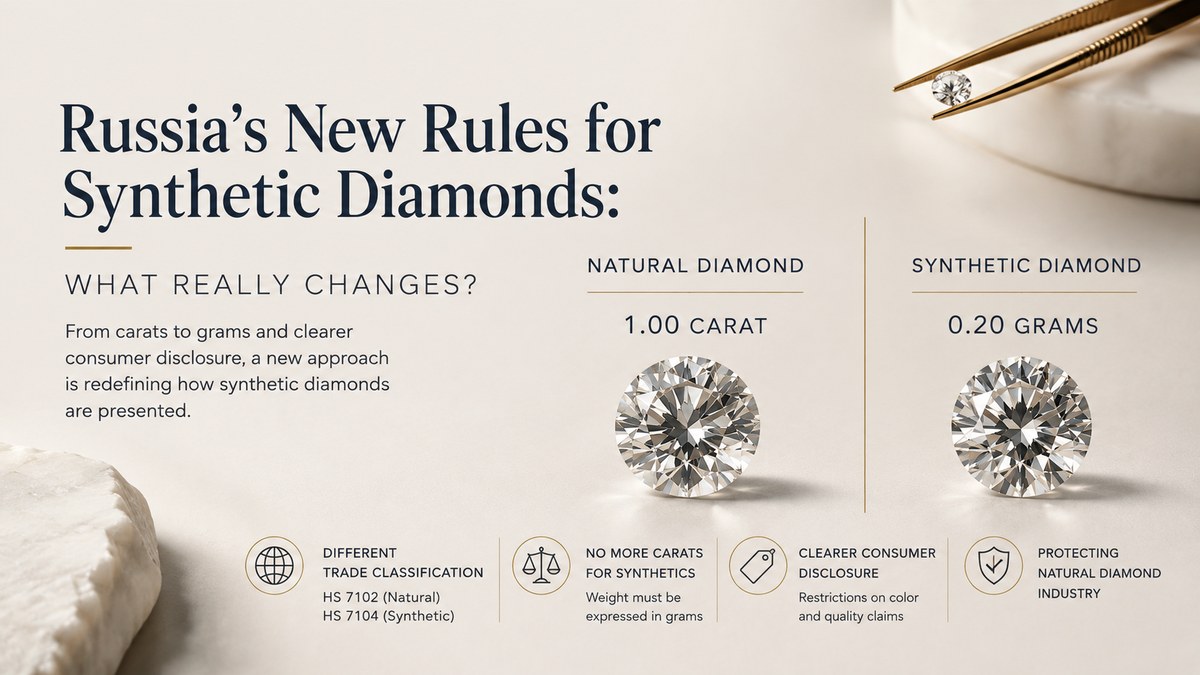
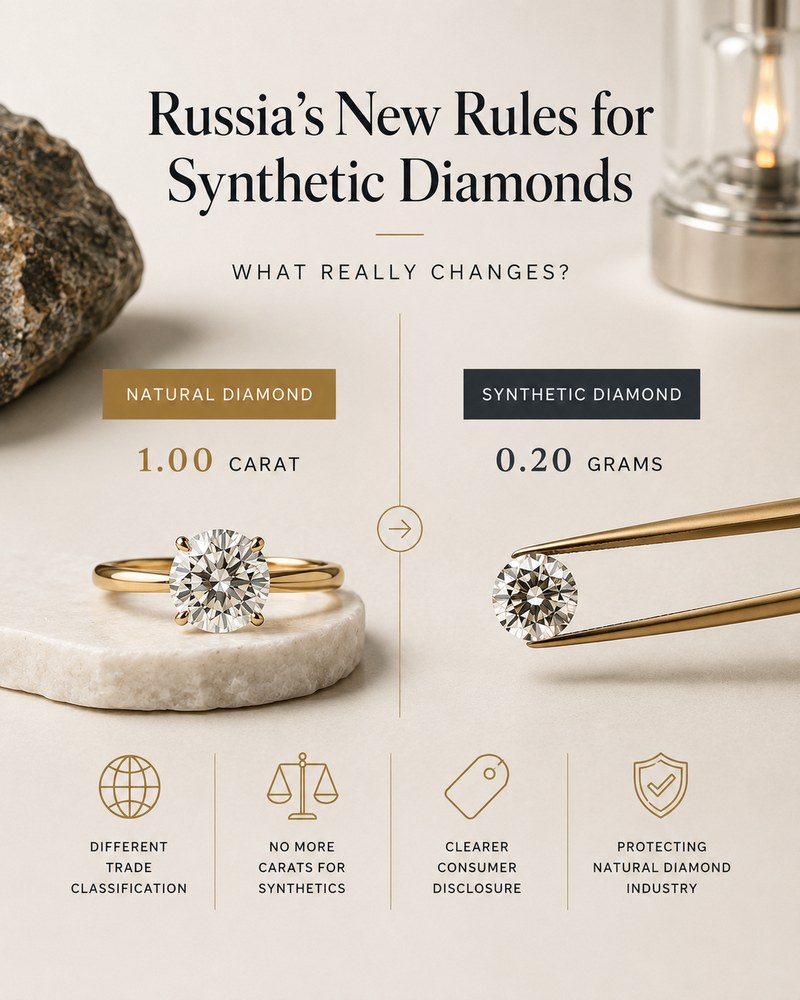
Under the new rules, synthetic diamonds sold to consumers in Russia can no longer have their weight described in carats. Instead, their weight may be expressed in grams.
That is a much more drastic change.
The carat is one of the most universally recognized measurements in the diamond industry. One carat equals 0.2 grams. So instead of communicating a stone as a “1-carat synthetic diamond,” its weight would be expressed as 0.2 grams.
FROM A TRADE PERSPECTIVE, “SYNTHETIC” ISN’T NEW. WHAT’S NEW IS HOW FAR RUSSIA IS TAKING THAT DISTINCTION AT THE CONSUMER LEVEL.
If I were Russia, would I do the same?
Probably, yes.
Russia is one of the world’s largest producers of natural diamonds. In 2024 alone, the country produced more than 37 million carats of rough diamonds, according to Kimberley Process data.
Looking at the decision purely from an industry and commercial perspective, I can understand the logic.
If a country has such a significant position in natural diamond production, it makes sense that it would want to protect that industry and create a very clear distinction between natural and synthetic diamonds in the eyes of consumers.
That doesn’t mean every market should necessarily adopt the same approach. But if I were in Russia’s position, I would probably want to protect my natural diamond production too.
Where does this leave the diamond industry?
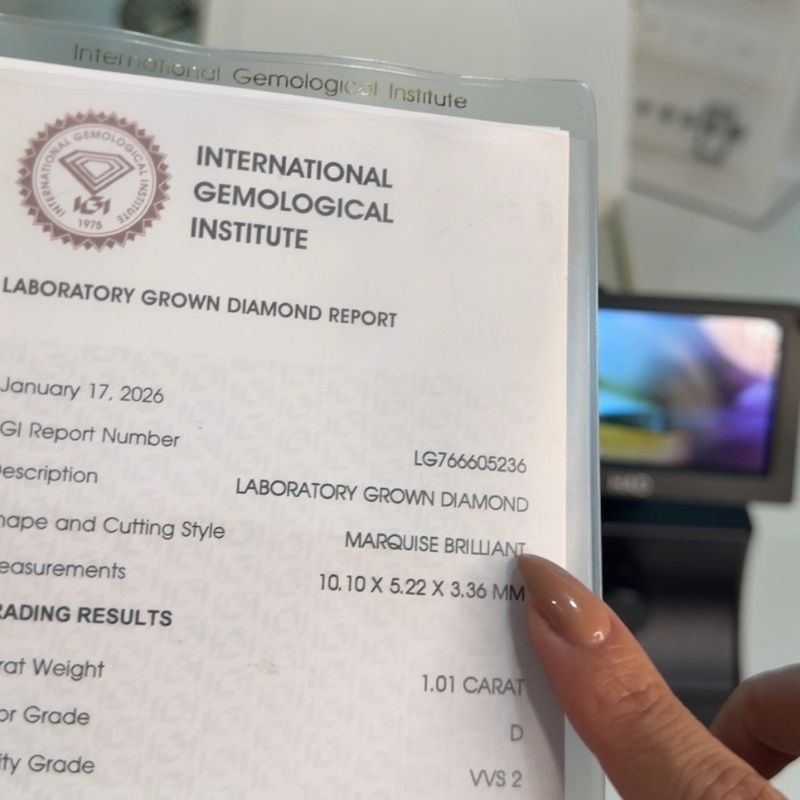
Natural and synthetic diamonds are already two distinct commercial categories. We see it in their pricing, supply structures, customs classifications and, more recently, in the way GIA reports laboratory-grown diamonds.
Russia is now taking that distinction further at the consumer level.
For me, the most significant part of these new rules isn’t the word “synthetic.” From a trade perspective, that distinction already existed. It’s the decision to remove carat weight, one of the most established measurements in the diamond industry, from the way synthetic diamonds are presented to consumers.
The official objective is consumer transparency: making the distinction between natural and synthetic stones much clearer. But considering Russia’s position as one of the world’s largest producers of natural diamonds, it is difficult not to look at these rules from a broader commercial perspective as well.
What will be interesting to see is whether these rules remain primarily about consumer transparency or whether they also become part of a broader effort to reinforce the value and positioning of Russia’s natural diamond industry.
What happens when wearable technology becomes part of personal style? Inside ADRIA x SOMA, a collaboration between two Peruvian brands exploring smart rings, wellness
Desde los diamantes ovales y el oro amarillo hasta los diamantes de laboratorio de mayor tamaño, esto es lo que estoy observando entre los clientes de anillos de compromiso en Perú y cómo se compara